In the market, differing terminology surrounding the so-called product passport and its various forms is causing significant confusion among industry and retailers. The term has been used for years in the contexts of sustainability and the circular economy, but it is not uniformly defined by law. Rather, it describes the concept of providing information in a structured manner throughout a product’s lifecycle. The following article explains what content and requirements lie behind each term and how the “product passport” requirement can be optimally implemented using digital solutions.
Definition: Product passport, Digital Product Passport (DPP), and material passport are concepts for the structured provision of product data throughout the entire life cycle.
Who does it affect? All companies along the value chain—especially manufacturers, distributors, and recyclers.
What is the solution? The Digital Product Passport (DPP) is being introduced as an EU standard and forms the central foundation for transparency and the circular economy.
Evidence: The EU Ecodesign Regulation (ESPR, 2024) will make the DPP mandatory for many product groups in the future.
Product Passport: An Approach and Concept for a Circular Economy in Practice?
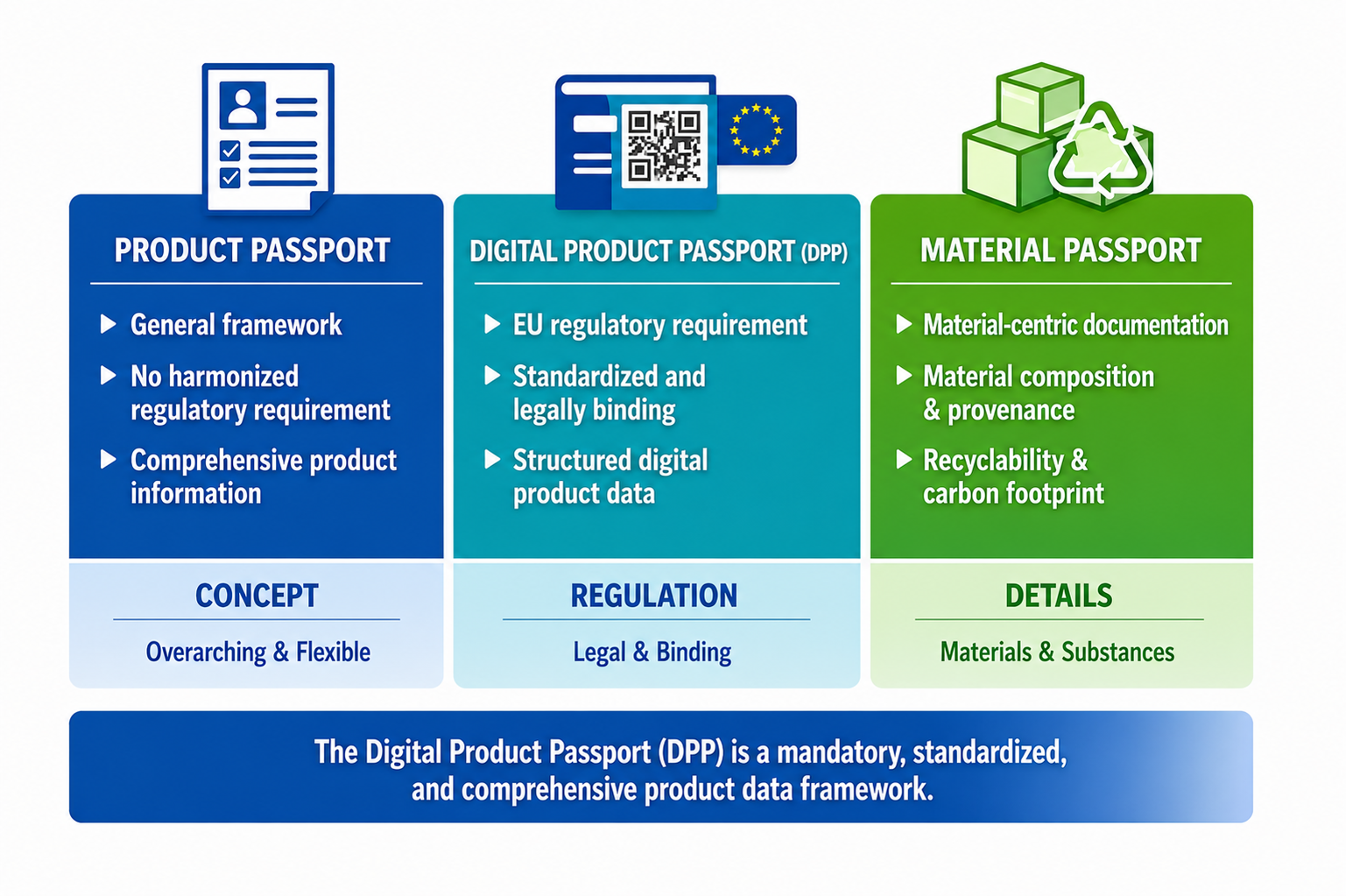
The top level of the passports is the product passport. Generally speaking, the product passport is an overarching, information-rich dataset about a product. It serves to create transparency regarding origin, composition, use, reparability, and disposal. The product passport is not based on any specific legislation. Rather, it is guided by the principles of the circular economy, the sustainability reporting, the Ecodesign Regulation, and other topic-specific European standards. The product passport is therefore relevant for all companies and industries.
Typical contents of a product passport include:
- a unique product identifier
- manufacturer information
- information on composition (substances, materials)
- environmental information (e.g., carbon footprint)
- usage and maintenance instructions
- end-of-life information (recycling, take-back)
Digital Product Passport: EU-wide Standard in Accordance with the Ecodesign Regulation
Above all, the Digital Product Passport (DPP) has become a major topic in many publications and introduces far-reaching requirements—though it is often unclear in what context these are set and what their concrete implementation should look like in practice. The Digital Product Passport is the EU-wide standardized, digital evolution of the product passport. It will be mandatory for many product groups in the future. The central legal basis for this is the EU Ecodesign Regulation for Sustainable Products (ESPR)—officially: Regulation (EU) 2024/1781, which entered into force in mid-2024 and establishes the requirement for the DPP.
Technically, the Digital Product Passport must be designed as follows:
- digitally accessible (e.g., via QR code),
- machine-readable + human-readable data in a standardized format,
- with role-based access rights (public / restricted).
In terms of content, the DDP, as a digital ecosystem, is generally divided into the following categories:
- Product identity (unique ID, model, version)
- Manufacturer and supply chain information
- Material and substance information (including substances of concern)
- Sustainability metrics (carbon footprint, durability, etc.)
- Repairability
- Spare parts
- Maintenance
- Disassembly information for recyclers
- End-of-life instructions, conformity information (e.g., standards, certificates)
The challenge for companies is that the Ecodesign Regulation is merely an EU framework law. For it to become legally effective on a product-specific basis, a multi-stage process must be followed. The key point is this: While the Regulation itself is directly applicable, it only becomes binding through product-specific delegated acts or implementing acts. Since the specific requirements may vary, there will be a separate delegated act for each product group, such as batteries, textiles, furniture, electronic devices, or steel/aluminum/plastics.
This involves not only defining product-specific DPP content but also establishing transition periods for implementation and determining the level of detail required for individual pieces of information. For batteries, this has already been addressed by the Battery Regulation, while similar acts for textiles, furniture, and electrical appliances are expected within the next 12 months.
Material Passport: What materials are contained in my product?
The material passport represents the smallest subset of the product passport. The material passport is a dataset that explicitly focuses on the materials contained in a product. It focuses on the material level and does not consider the entire product. There are now several initiatives and research projects driving the standardization of the material passport—including its content requirements. The goal of the material passport is to increase transparency regarding material quality, quantity, origin, the substances contained within, and reusability.
As with the product passport, there is no specific European law requiring the material passport. Nevertheless, there are several guidelines that address the material passport in context. These include:
- Circular Construction
- DGNB Certification / Cradle-to-Cradle
- EU Circular Economy Action Plan
- Building and Resource Passports
The main focus is currently on the construction sector and the requirements of sustainable construction, as well as on other industry-driven initiatives. The typical contents of a material passport are:
- Material types and quantities
- Origin and certifications
- Toxicological data
- Reusability / Recyclability
- Carbon footprint per material
- Disassembly and sorting information
What are the differences between these terms?
In summary, this means that only the Digital Product Passport has a potentially legally enforceable basis. The general Product Passport, as well as the Material Passport, are based solely on derived legal obligations and should be viewed as voluntary. Nevertheless, this does not mean that manufacturers or distributors can consider themselves exempt from their obligations. If we examine the points common to all passports, it quickly becomes clear that the EU requirements are still extensive and require considerable effort to provide the relevant data. The processes and operational implementations necessary for this can take several years.
How can product passport requirements be implemented using software?
Product passport requirements can be efficiently addressed through integrated software solutions and data ecosystems.
Key requirements include:
- structured data collection throughout the product lifecycle
- integration of supplier data
- calculation of sustainability metrics
- provision of standardized data formats
Modern systems combine various modules—such as CO₂ calculation, recycling assessment, and compliance management—into a single platform.
What do the general requirements mean in detail?
The first requirement common to all passports is the need to collect relevant data in a structured manner and to describe the core elements of the product or material in question. These include product properties, product composition, origin, service life, and end-of-life information. Here, the focus is not limited to the manufacturing of the product, but encompasses the entire life cycle—including use and maintenance, repair, as well as disposal and recycling.
A key requirement of all product passports is the promotion of a circular economy. In this regard, the general sustainability guidelines apply, such as
- the ability to reuse the product,
- facilitating repairs,
- recovering the materials contained in the product, or
- improving recyclability through forward-thinking product design.
An equally important goal is to improve transparency among the various stakeholders. To this end, the passports serve as a communication platform between:
- Manufacturers
- Retailers
- Customers
- Repair shops
- Recycling companies
- Government agencies
In many cases, this exchange should also take place bilaterally, so that, for example, the manufacturer not only has to provide information to a waste management company but also receives information from the latter regarding the composition of products and components. With these requirements, all passports aim to minimize a product’s environmental impact throughout its entire production and life cycle, reduce resource consumption, prevent waste, and lower CO₂ emissions.
What do the requirements mean specifically for companies in Europe?
Companies must prepare for the Digital Product Passport early on, as it will become the central database of the future.
Specifically, this means:
- Establishing robust data structures
- Transparency regarding material composition
- Integration of sustainability metrics
- Collaboration across the entire supply chain
The DPP will become the “benchmark” for all future product data in Europe. It is already mandatory for some product categories and will likely become a requirement for others within the next 12 to 18 months.
Product data, insofar as it serves sustainability goals, always requires basic information on the substances that make up the materials or products. Only with this information can subsequent requirements—such as toxicological assessment, recyclability, and circularity, as well as the carbon footprint—be met. The determination of circularity, in turn, can only be demonstrated if comprehensive recycling information and data from secondary markets (technical possibilities and prices) are available.
DataCross: All DPP Requirements in one System
To manage the various data streams, a range of ecosystems has emerged, designed to connect a wide variety of stakeholders. As is always the case when different stakeholders, each with their own interests, work together in a shared data environment, the hurdles to coordination regarding data interfaces and data formats are high. For this reason, tec4U-Solutions has developed its own ecosystem, which, building on the Material Compliance modules of DataCross www.data-cross.de, includes the following additional functional modules and applications:
- A CO₂ module (co2-cloud.com) for collecting the necessary emissions data (SCOPE 3) in the supply chain and for creating Product Carbon Footprints (PCFs) according to industry standards (including SCOPE 1+2)
- A recycled content module for the use of secondary raw materials in products
- EcoValueHub https://ecovaluehub.com/ for visualizing the disassembly process and calculating circularity metrics
- A module for mapping the digital product passport material-passport.de, which provides information to potential users via a web application, depending on their authorization.
DataCross consolidates information from various sources—including data collection at the supplier, operational disassembly, the analysis and calculation of necessary process data, and the generation of required reports and data content for the Digital Product Passport—into a single integrated system.
Takeaway
- The Digital Product Passport is becoming mandatory in the EU
- Product passports create transparency across the entire lifecycle
- Material passports provide the necessary depth of data
- Companies must establish data structures early on
- Software solutions are crucial for implementation
- The circular economy is the central goal
- With DataCross, all requirements are mapped within a single system
Conclusion & FAQs
The Digital Product Passport marks a fundamental shift in how product data is handled in Europe. While the traditional product passport serves as a concept and the material passport provides the necessary level of detail, the DPP becomes the binding foundation for transparency, sustainability, and regulatory compliance. Companies that invest early in data structures and systems secure long-term competitive advantages and efficiently meet future requirements. DataCross from tec4U-Solutions provides the best platform for researching and evaluating the relevant data in the supply chain to populate your Digital Product Passport and for effectively filling the Digital Product Passport with content.
A dataset that focuses on the materials used in a product and their properties.
A standardized, mandatory digital record for products across the EU.
An overarching concept for collecting all product-related information throughout the entire life cycle.
No, only the Digital Product Passport is gradually becoming mandatory.
It creates transparency, supports sustainability, and meets regulatory requirements.
All companies along the value chain—from manufacturers to recyclers.

Gülistan Dar, Betriebswirtin (M.A.)
Gülistan Dar is Head of Corporate Compliance at tec4U-Solutions GmbH, a provider of digital sustainability solutions. She has been working on ESG issues for several years, both in customer projects, process consulting, workshops, and training courses. Her focus is on the practical implementation of the requirements of CSRD, VSME, eco-design (digital product passport), and the EU Taxonomy Regulation. She is trainer for the TÜV courses “Material Compliance Officer” and “CSRD Officer,” gives specialist lectures, and writes articles for industry magazines.

Stefan Nieser, M.Eng., Dipl-Ing. (FH)
Stefan Nieser is the managing director of tec4U-Solutions GmbH, a provider of digital sustainability solutions. Since 1992, the engineer has been supporting industry and trade as an expert in the implementation of material compliance requirements and circular economy. His areas of expertise are process and development consulting as well as compliance audits. He is a QM, hazardous goods, and environmental officer, former lecturer for process design and sales at the HTW Saarland University of Applied Sciences, speaker, and publishes numerous technical articles in industry magazines.